
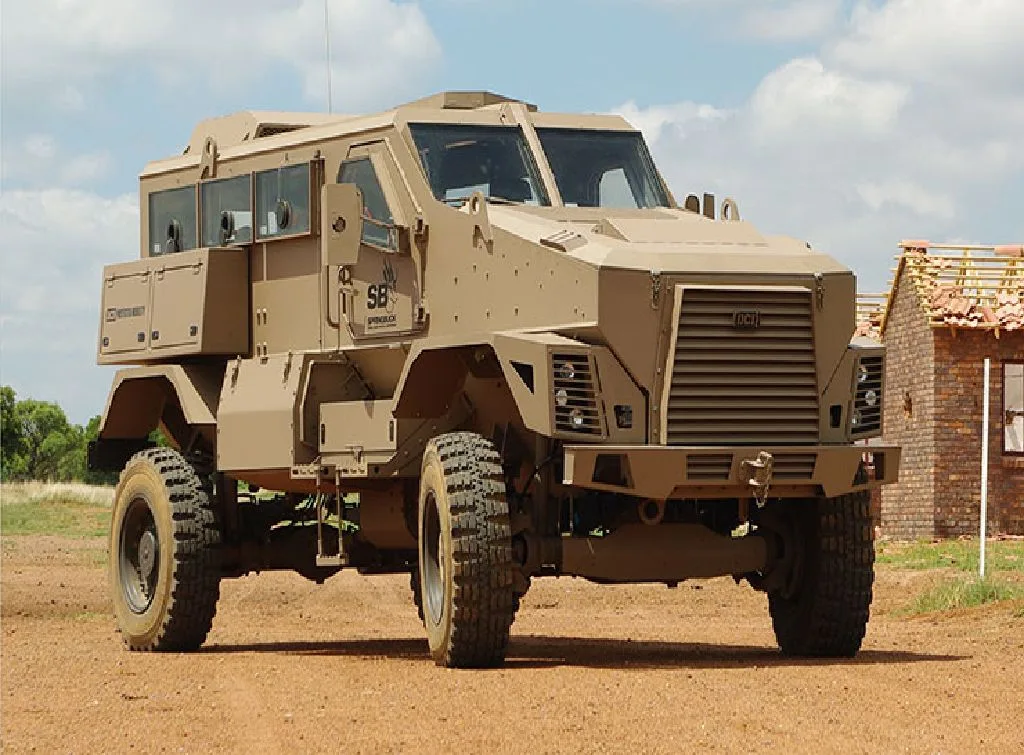
Defence and security
Runflat inserts and beadlocks for military and armoured vehicles
In the early 1980s the UK Ministry of Defence asked Tyron for steel bands for its Land Rovers. The range now covers rubber runflats (run-flat inserts), beadlocks and bolt-together wheels for armoured and security vehicles.
What these fleets need
Range on deflated tyres
TÜV tested on a 17-inch ATR, Toyota Fortuner: 100 km at 50 km/h on two deflated tyres, then 50 km at 30 km/h on all four.
Field-mountable
Multi-piece ATR systems fit without a hydraulic press, which simplifies logistics.
Durability off road
Rubber runflats for conditions where plastic types can break, or break the wheel.
One source
Finished wheel assemblies with Michelin, Pirelli or Continental tyres through our partnership with Global Wheels of South Africa.
Testing
Tested to Finabel, and well beyond it.
Tyron’s ATR runflats are tested against the internationally recognised Finabel standards for distance and speed, and for ballistic damage. In every test the ATR exceeded the requirement.
TÜV · Distance on deflated tyres
100 kmat 50 km/h with two tyres deflated, then a further 50 km at 30 km/h with all four deflated.
17-inch ATR on a Toyota FortunerBallistic · 7.62 mm rounds
35 roundsagainst the 7 the Finabel test asks for: 20 through the sidewall and 15 into the tread.
Direct hits on the fixings ricocheted or passed through without structural damageTÜV · Handling course and slalom
3 + 3 kmat 80 km/h, then at 50 km/h, through a handling course and slalom.
Multiband, on a range of vehicles. Certificate and video available| Ballistic test | Finabel asks for | Tyron ATR tested with |
|---|---|---|
| Rounds through the sidewall | 5 | 20 |
| Rounds into the tread | 2 | 15 |
| Total | 7 | 35 |
Why results vary
Results depend on speed, weight, tyre aspect ratio, age and make, road conditions, the cause of deflation, ambient temperature and another major factor, the vehicle’s suspension. Ask us for the test documents and we will help you judge them against your own vehicles and conditions.
Request the test documentsQuestions buyers ask
Why rubber runflats instead of plastic?
Where roads are poor or vehicles work off road, plastic runflats can break, or cause the wheel to break, even in normal driving. Tyron ATR runflats are rubber.
Can the runflat be fitted in the field?
Yes. The ATR-MP is a patented multi-piece runflat that fits and comes off without a hydraulic press or special tools, so it can be mounted and removed in the field.
How far can the vehicle drive on deflated tyres?
The ATR-MP is rated for up to 150 km, and the minimum guarantee across the ATR range is 50 km. In TÜV testing a 17-inch ATR on a Toyota Fortuner covered 100 km at 50 km/h with two tyres deflated, then 50 km at 30 km/h with all four deflated.
Does it meet Finabel?
Finabel 20.A.5 and A.20.A require a guaranteed minimum runflat distance of 50 km, preferably 75 km, and two hours off road with two tyres deflated. The ATR with R4 and R6 wheels was independently tested by TÜV to exceed the Finabel standards.
Has it been tested ballistically?
Yes. The ATR took 35 rounds of 7.62 mm, 20 through the sidewall and 15 into the tread, against the 7 the Finabel test asks for.
How does the beadlock work?
Rubber runflats are made wider than nominal, so they compress the tyre beads against the wheel flanges and keep clamping force whatever the tyre make. R4, R6 and R7 wheels provide beadlock to the Finabel standards when an ATR is fitted.
Is the range NATO approved?
Yes. The ATR range and Multibands are approved by NATO and carry NATO stock numbers, supplied on request.
What standard are the wheels made to?
All Tyron-supplied wheels are manufactured and tested to a minimum of SAE J1992.
Every vehicle is different.
Systems depend on the vehicle, wheel and mission. Our engineers will show you how the right system works on your fleet.